Review of The Mortal Instruments: City of Bones Movie

Mortal Instruments City of Bones Movie Poster

The Basics (spoiler free): I did not want the hours of my life back. However, there were scenes where I audibly groaned or yelled, “Oh, puh-lease!”  The movie did a good job of portraying the world of the Shadowhunters, and the action scenes were tense and interesting. The movie was fairly true to the book, but the changes that were made ranged from mildly irritating to one that was downright infuriating. Most of the cast was great.

Grade: B-

More in depth analysis that assumes you have read the books, so SPOILERS if you haven’t:

Just so you know where I’m coming from, I have read all of Cassandra Clare’s wonderful books in the Mortal Instrument series as well as the Infernal Devices prequels. I was excited about the movies, and would say I went into the movie with reasonable expectations. I know that movies will never be the books. Screenplays are usually about 120 pages, so they are never going to be as rich as the book itself. This outlook allowed me to enjoy the Harry Potter movies and the first Hunger Games.

On the whole, the casting decisions were great. I was particularly pleased with Jamie Campbell Bower’s Jace. I had some mild reservations about him playing Jace, and my friend who went with me had been lamenting JCB’s casting for months, and she also freely admitted that he was perfect as that character. I felt Lily Collins represented Clary well, and Robert Sheehan was a breakout as Simon.

The notable exception to the otherwise impressive cast was Godfrey Gao as Magnus Bane. Gao has a great look for Magnus, but the man cannot act. You know how sometimes SNL will have a host who’s an athlete or a musician instead of an actor, and it’s just painful to watch sketch after sketch? Yeah, it was like that. Thankfully, Gao was only in two scenes, but I winced my way through both of them. As Magnus is the only character in all of Clare’s books, I think a recast might be in order. Every single one of her books has been optioned, including the Shadowhunter books she hasn’t even written yet. That’s a lot of bad to have to sit through although one would hope Gao would get better by the twelfth movie.

Godfrey Gao as a terrible Magnus Bane

Other than Gao, the most offensive parts of the movie were, not surprisingly, the parts Hollywood added in for no reason that I can ascertain. There was an unforgivably bad storyline about how Bach was a Shadowhunter. If you play his music without passion, you can irritate demons enough to show themselves. Even my friend who had not read the books found this so ridiculous that he covered his face with his hands and groaned. The film even shot to a portrait of Bach in his puffy wig where you could see the dark runes peeking out of his collar. Ugh. I assured my friend that none of that nonsense was in the books.

Bach as Shadowhunter nonsense.

Another particularly horrible scene was the one in which Jace and Clary kiss. This is a moment that I’m sure all fans of the books have been waiting a long time to see play out on the big screen. If you are twelve, then maybe your expectations were fulfilled. They were in a garden. Fine. Then the dialogue got awful, the kind of sap that Jace would have mocked in the books. Then—I am not making this up—suddenly there were little twinkly somethings everywhere. I don’t even know what they were. Fireflies? I’m praying they were witchstones to at least stay with the plot somehow. Then the music (which was pretty awful throughout the movie) swelled with something way melodramatic, AND THEN it started raining AND THEN flowers burst into bloom everywhere. They kissed! Eeee! And I threw up a little bit.

Jace and Clary in the Garden of Twee

I feel I must point out, though, that part of why those two scenes stood out so much is because for most of the movie I was quite happily absorbed in the world of the Shadowhunters. All of the fighting scenes were good. The demons were appropriately creepy and gross. As out of character and stupid as the kissing scene was, the one that followed it where Jace makes a snarky comment about Simon being in Clary’s bed was spot on.

There were a number of other changes or cuts that even if I wasn’t thrilled about them, I did understand. Alec came off as a little stilted, and Magnus and his storyline was hardly touched. Neither was Simon and Izzy’s initial tension. In fact, poor Izzy didn’t get much in way of development. Alec and Izzy’s parents aren’t even characters, nor is Max. Simon’s run in with the vampires is much abbreviated, as is all of the Daylighter stuff and his struggles with his faith and mother. The Silent Brothers, City of Bones, and the Clave were touched on so briefly that my friend who hadn’t read the books didn’t really follow most of it. He also never made the connection that Luke was a former Shadowhunter.

All of those things I can forgive—maybe even Jonathan Rhys Meyers’s ridiculous dreadlocks. The movie was trying to fit a dense book with a very complicated world into two hours. You have to pick and choose what you focus on. I felt the screenwriter made the right choice by initially focusing on Clary and her relationship with her mother/Luke/Valentine and Jace/Simon. Everyone else can be fleshed out in subsequent movies.

What the movie did that was unforgivable was reveal a major plot twist that isn’t sorted out until a few books later. Not only did the screenwriter divulge the secret, she did it as a casual aside between Hodge and Valentine. That’s right sports fans, Hodge says almost as a throw away, “Lie to them and tell them they’re related.”  Oh no, I will climb over these theater seats into the screen and throttle someone for that. Not only did you just ruin a major tension between Jace and Clary for the casual moviegoer, but then the movie also immediately proceeded to confuse the issue even more. By implying that Jace was given false memories, my friend who hadn’t read the books did not understand that Valentine had actually raised Jace. That abusive relationship explains so much of Jace’s future actions.
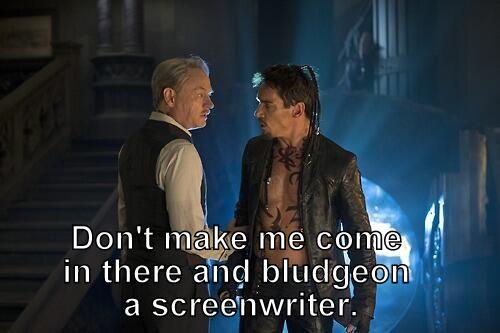
Anger against screenwriter decisions

So the first Mortal Instruments movie was definitely a mixed bag. I think it did more right than it did wrong, but when the movie screwed up, boy did it screw up.

Thoughts? If you read the post this far, I’m assuming you also read the books. Are you planning to see the movie? Why or why not? If you already saw it, what did you think was done well? What could be improved for the next movie?
What Can Make Even a Loyal Reader Ditch Your Book

I am loyal to the point of folly. People, I watched season seven of Supernatural. Every. Single. Episode. The Geneva Convention is holding talks about whether Netflix should be required to pull those 22 hours of slow torture. It was horrible, but, by golly, I had logged a lot of miles with Sam and Dean in that Impala, and I was not giving up. I’m glad I didn’t since season eight was greatly improved, and I’m downright giddy about season nine.

I am just as teeth-clenched determined when it comes to reading.  Robin McKinley wrote two of my favorite young adult books, The Blue Sword and The Hero and The Crown. Her adult fiction can be sort of hit or miss for me, but I will read every page. I had to check out Sunshine on three different occasions over two years to get through it. It ended up being excellent, but the beginning was painfully slow. If Robin McKinley’s name hadn’t been on the book cover, I would have chucked the thing out the window the first time. But I am LOYAL.

Pushing through a boring book.

I have a professor friend who because of time constraints and because she reads slower than I do, has to be aggressively picky about what she reads. She has a formula for how many pages she will read of a book before she decides whether she’ll continue. It is as follows:

100 – (your current age) = the pages you allow the author to woo you

She’s 35, so she gives a book until page 65. I’m generous. I’ll give you 200 because I’m really hoping you’ll have a miraculous turn around half way through.

Even so, I’ve had a rough time lately with books. I returned more unfinished books in the last six months than I ever have before. Others I finished out of sheer tenacity, but I never grew to like them.

All of the books were critically acclaimed and from a literary perspective were well written. Some were the author’s first book, others were not. Two were science fiction, two were fantasy, two were mainstream fiction. What united them was their universal problem:

I did not care what happened to the characters. Not at all. Not a one. Zilch, zip, nada. Blow them all up, heroes and villains alike, and I would have slept like a baby.

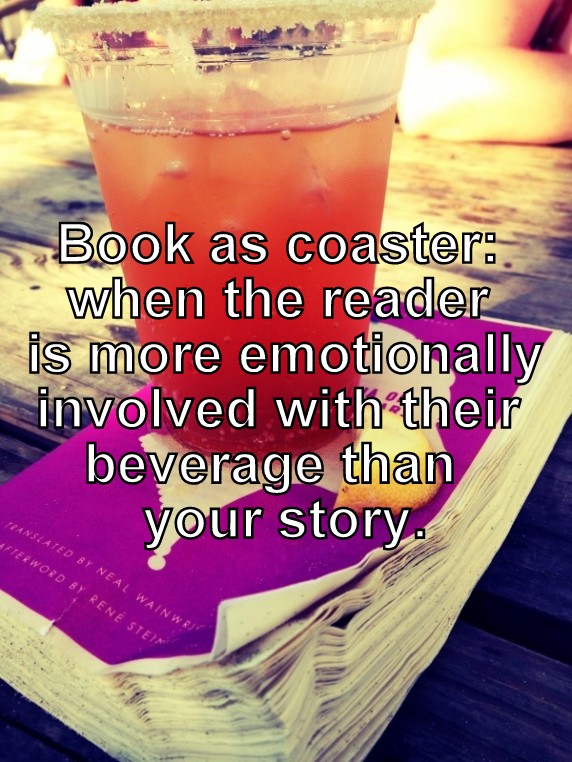
Readers should care more about the book than their beverage.

The authors were very good at other aspects of the writing. The fantasy writer was a masterful world builder. He created one of the most interesting systems of magic I’ve ever seen, and then he plopped down a set of characters into it with all the relatablity of dry toast. Both of the science fiction writers wrote wonderful scenes of tension and suspense that I made notes on. One of the mainstream writers had lovely description of the world of her two protagonists. Sadly, her setting had more depth than her characters.

At the same time I read these books, I was alternating reading a series of paranormal romances. You know the type. They have the kind of covers that encourage you to buy an e-reader. The writing is atrocious. Every single time I read one I wonder how this author ever got a publishing contract. The dialogue is cringe worthy, and she is constantly telling instead of showing. BUT—this is huge—I am currently reading the ninth book in this series. These horribly crafted things are New York Times bestsellers. I continue to plod through the inferior writing because the author made me care about her characters.

If you make me fall in love with the people in your story, I will put up with a lot. I watched plots revolving around Pepperjack Turducken Slammers(! ) because I had already loved Sam and Dean Winchester for years.   If I don’t care a lick about your characters, I don’t care how pretty your prose is, I’m chucking your book.

Dean eats a Turducken Sandwich.

In the words of the great Sol Stein, “The fiction writer’s primary job is creating an emotional experience for the reader.”

So, please, make me feel something.

Questions for comments:

  1. Think about your favorite book. Why did you like it? Was it the writing style or the characters?
  2. What makes a good character?
  3. What makes a reader apathetic about a character?
  4. Why do you most often abandon a book?

10 Things This Summer That Brought Me Joy (and that you might not know about)

Durham is home to two universities and is spitting distance from two more plus a number of small liberal arts colleges and community colleges. It doesn’t matter if you’re in school, you know someone who is, or you have a friend who teaches for a living. This week the city gave a collective sigh as teachers and students alike acknowledged the end of summer. As a former teacher, I couldn’t help a moment of schadenfreude as I cackled with delight.

Don’t worry; I felt guilty about it later.  It got me thinking about what I had enjoyed the past few months. I’m sure there will be numerous top ten lists of the summer arguing which was the definitive movie or song. I saw my fair share of blockbusters involving superheroes and cheered on John Oliver’s turn at the Daily Show desk, but I wanted to share with you the things that delighted me and fed my creativity that aren’t likely to receive as much press.

10. Searching for Sonny: I would never have found this movie if not for my fellow die hard Veronica Mars friend. We’ve both participated in the VM movie kickstarter campaign, which has been a joy all of its own this summer. Searching is a small indie starring VM’s Jason Dohring. I found myself absolutely delighted with the characters, plot, and zany humor. Everyone who watched that evening enjoyed it, and no one else even had any Veronica Mars nostalgia for Dohring.

9. The Middle: Despite already being on for four years and coming on before Modern Family, somehow I knew nothing about this show. After asking around my social groups, I discovered I wasn’t alone. Let me clear it up for you. It’s about a family living in the fictional town of Orson, Indiana which is in the middle of nowhere. I don’t know if this show would appeal to everyone, but as someone who is from nowhere, Indiana, I laughed so hard through the pilot that I frightened the cat. My husband, who is from the Washington, D.C. area, is constantly asking, “Do they actually do that?”  Yes. The answer is always yes.

Will Gordon headshot

8. Will Gordon: Gordon would probably rank even higher on this list if he’d write more often or if I could find a regular blog for him. So far I’ve only been able to find his food/beer related posts on Kinja and Twitter. I’m not even interested in most of the topics he writes about, but he is so freakin’ hysterical. If Gordon wrote about tax law, I would probably read it. He’s foul mouthed and steps way over the lie sometimes, but I can’t drink anything while I read his posts for fear I’ll choke.  Eureka!  He does have a blog, although it’s somewhat neglected.

Bianca Giaever

7. The Scared is scared: I might have actually seen this first in the spring, but it continues to delight me into the summer. It’s a student film that a friend of mine at NC State brought to my attention. He’s a design guy, and I think the filmmaker Bianca Giaever runs in his circles. It’s eight minutes of exquisite storytelling with a 6-year-old narrator. It also happens to hold a huge amount of wisdom on how to face fear.

Warning:  The Silver Linings You Tube clip below contains adult language.

6. Silver Linings Playbook: Yes, by now you’ve probably heard about this movie, but have you actually seen it? I didn’t get around to watching it until it came out on DVD. Still, I don’t know how many times I’ve started a conversation this summer with, “Have you seen it?” and been shocked to have the conversation immediately halt when the person has to admit they haven’t. Part of the problem I think is that people don’t know what this movie is. Romantic comedy? Drama about mental illness? As one of my friends put it while watching, “I’m feeling all the feels.”  It’s everything, and it’s fantastic. It’s one of the best movies I’ve seen in years. As much as I enjoyed Argo, I’ll admit now that SLP should have taken best picture. One of the best scenes is Bradley Cooper’s completely appropriate reaction to reading Hemingway.

5. Hamish and Andy: My husband and I lived in Australia for a few months, and while we were there, we discovered the gem that is Hamish and Andy’s Gap Year. It’s somewhat difficult to describe as we don’t really have an American equivalent. Two nutty guys go to a different country or continent every summer and explore the oddest things they can find and participate in crazy schemes. For example, the summer they went to the United States, they staged a fake dating show in New York to get Andy a date, launched a whole campaign to get Hillary Clinton to invite them for a BBQ, and entered a “hollerin’” contest in North Carolina. This summer they’re in Asia, and we’re laying bets they’ll get arrested at some point. The TV show is our favorite, but they also have a year round radio show.

Daisy Cakes bakery in Durham, NC

4. Daisy Cakes: All right, I know this one is a little cruel, because unless you’re local, you can’t really enjoy it. Still, I couldn’t talk about summer joys without including it. Daisy Cakes is a small but cheerful bakery downtown that serves Counter Culture Coffee (another Durham institution, but one that is available nationwide) and mouth-watering baked goods. They also do a mean carnitas sandwich. Every writer needs a favorite spot to escape to, and Daisy Cakes is mine.

3. Lowland Hum: I have never been hip to “the local music scene.”  Mostly because I’ve never been hip. However, I have made an exception to my complete lack of music coolness for this folk duo. I’ve heard them do a number of short sets this summer and attended one full house concert, and I’m enchanted. Their concerts are multisensory with an art installation behind them, lavender oil burning, fresh flowers placed around, handmade lyric books to hold, and even bread to taste. It’s hospitality in music form. They’ve just started a tour with the release of their new album Native Air, so they might be coming your way.

2. Orphan Black: You might have at least heard murmurings about this show by now, produced by BBC America. Perhaps you have a friend like me that every time you see her, she whines, “Have you watched it yet? C’mon, watch it already!”  I’m not one given to spoilers, but I’ve decided it’s okay to tell people it’s about clones. Clones! All of them are played by the masterful Tatiana Maslany, who was robbed! Robbed, I tell you! She should get all the Emmys! All of them!

Price Peterson head shot

1. Price Peterson: It was a sad day in Whoville when Price Peterson left TV.com in January to work on a TV pilot. He returned this summer with a quip about dreams dying (sorry Price!) but then immediately launched back into his TV recapping genius. I was a little bit sad for him, but very happy for me. Much like Will Gordon, I don’t care what he writes. I will read whatever Price recaps, even if I don’t watch the show. He’s just so earnestly funny. It’s my good fortune that one of the shows he does is The Vampire Diaries. If you’d like to try a quick taste of Price, you can try his Sharknado recap.

So that was my summer. What brought you joy this summer? What hidden treasures can you share? I’m sad to say I couldn’t offer any fantastic books on my list. I seem to be on a spree of ho-hum books. I did read a couple good ones this spring, but nada this summer.


Mythic Villains: Bring on the Big Bads

With this post, we’ve reached the end of our Hero’s Journey, the monomyth based on the writings of Joseph Campbell. The Villain is the last of our cast of characters, and like the Hero, he has a very specific list of qualities.

Much like the Hero, who is supposed to be unambiguously good, there needs to be no question that the Villain is evil. Remember the motto from the producers of Seinfeld: No learning and no hugging. Your Big Bad can’t be misunderstood, can’t be redeemed, and can’t be conflicted. The Villain is often called the Evil One in the monomyth and with good reason.

Seinfeld finale in jail

The Seinfeld finale drove home the “No Learning” lesson. Your villain needs to be just as selfish as these four.

Interestingly, he or she shares a number of qualities with the hero:

  1. Hubris, although in his case, it might be a straight up big head.
  2. An outlaw, but in the true sense of the word. The Villain is a criminal, not just a little rebellious.
  3. Clever and resourceful. A stupid villain easily duped isn’t a worthy opponent. Also, someone who was tricked into doing the wrong thing isn’t truly evil.
  4. May be wounded, giving him an excuse to do evil. This characteristic is terrifically important for making a three-dimensional villain. The mythical Evil One can easily descend into a cat-stroking, cackling caricature. The wound explains the motivation for his actions, but it cannot make us sympathetic. Don’t make your villain evil for evil’s sake, but make him appalling enough that even knowing his back story, we find him despicable.
  5. Have a special talent, which he’s using for evil. If he has a knack for chemistry, for heaven’s sake don’t have him making medicine for babies and puppies. He should be concocting fowl poisons.
  6. Have great sex appeal. This isn’t required, but I’ve always found the good-looking villains infinitely creepier than the wart-covered oozy ones. However, you can’t have any great love affairs here. He or she will be using and manipulating their lovers for personal gain. Sure, they could fall in love, but they are first and foremost selfish, and nothing will change that. Remember, no learning.

The Evil One also has a number of qualities that are directly opposite of those listed for the Hero:

  1. Is motivated by greed, avarice, lust, lust for power, vanity, narcissism, and other moral flaws. With a list like that, it’s easy to slip into posturing and sneering, but keep the wound in mind.
  2. Is never motivated by idealism, only selfishness. There is one exception: the Evil One’s family. He’s allowed to do nice things for his family, but ultimately that is also a form of selfishness and vanity. They reflect on him.
  3. Is often cruel.
  4. Can win by luck.
  5. Is not forgiving.
  6. May quit, but only at the end.
  7. May whine, grovel, and complain. No need for him to suffer in silence.
  8. May not be loyal.
  9. May not be physically superior, although sometimes he has a sidekick or minions that are.
  10. Has no special birth or destiny, although he may claim one.

Not nearly as much direction is given about the Evil One as the Hero, but that should not mean that you spend any less time crafting a deep and well crafted antagonist. Kristen Lamb recently wrote an article about how a lot of writer’s block and sagging middles could in fact be due to poorly constructed antagonists.

Ben Linus LOL cat

When do you know you’re villain has captivated the public? When they start making LOL cats about him.

I, myself, realized that my first draft contained a cartoon villain. A strong antagonist can make a story come alive. How amazing was Lost after the writers added Michael Emerson’s Ben character? Did I like him? No. Did every scene he was in crackle with energy? You betcha. Why was the third season of the Vampire Dairies so amazing? The Originals, lead by Klaus. That set of villains was so good, a year later the CW has spun them off into their own show! Why was season four less interesting? Because the new Big Bad, Silas, is booorrrrring.

A word of caution, though. In your effort to make your Evil One interesting, don’t make him or her more compelling than your Hero. In this summer’s Star Trek, it became clear that someone was going to have to die. As the final showdown between Spock, Kirk, and Khan approached, Benedict Cumberbatch’s villain was so amazing that he was not my first choice to go. I’m not even sure he was my second. And I like both Spock and Kirk.

Related Reading:

Did That Monster Come Out of You? (Reflections on how to write the truly evil villains from the always great Charles Yallowitz)

Sort of Related Art:

I found this post on the art of Kiersten Essenpries, who did a series of pieces on what villains do in their spare time.  If you like her brand of kooky, you should check out the whole series at her website.

The Mythic Hero: Can He Ever be an Antihero? Can an Antihero be Female?

I’m a big fan of the Vampire Diaries. Yes, I’m 34, hold two college degrees, and I watch the Vampire Diaries. That is another discussion.  One of the main characters, Damon Salvatore, is your traditional bad boy antihero. Over the course of the last four seasons he’s redeemed himself somewhat, and he gave this wonderful bit of advice to the series’ main villain, Klaus, “If you’re going to be bad, be bad with a purpose. Otherwise you’re not worth forgiving.”

Vampire Diaries' Damon and Klaus

That, in a nutshell, is what separates an antihero from a villain. They are bad with a purpose.

What, then, separates the antihero from being a mythic hero?  An antihero by definition lacks the virtues and qualities that would make him heroic. If you’re writing a regular novel, your protagonist can be an antihero with no problem.  When you are writing a myth, however, you are writing about the epic struggle between good and evil. Experts maintain that a mythic hero must be unambiguously good, or the structure breaks down.

In James N. Frey’s The Key:  How to Write Damn Good Fiction with the Power of Myth, he lists the qualities of the mythic hero. (For those of you who didn’t read my previous posts about The Hero’s Journey and the characters the Hero meets along the way, you can click those links for more info.)

The Hero Must:

  1. Take the lead in a cause or action.  No reactionary heroes.
  2. Have courage, or find it in the course of the story.
  3. Be an outlaw or maverick of some kind, living by his own code.  This is only in the sense of him defying conventionality; he cannot be an actual criminal.
  4. Be good at what he does for a living.  He can’t be a lazy, surly employee before the call to adventure.
  5. Have one or more special talents that set him apart.
  6. Be clever and resourceful.
  7. Be sexually potent.

The Hero Can Never:

  1. Quit.
  2. Act cruelly.
  3. Whine.
  4. Grovel.
  5. Win by luck, although luck can play a part.

The Hero Usually (you can use these qualities or not—up to you):

  1. Is stoic.
  2. Is loyal.
  3. Is forgiving, or learns to forgive over the course of the story.
  4. Is considered sexually appealing (slightly different than sexually potent, which is a non-negotiable).
  5. Has a special birth (parent might be a king, doomed prisoner, a goddess, an Apache warrior, and the like).
  6. Is physically superior in some way (strength, speed, hearing, reflexes, etc.).
  7. Has a special destiny (predicted by a seer, perhaps).
  8. Has hubris (a big head, or at least seems to think he can do things most people can’t—an extra dose of stubborn and initiative might be another way to think of it.).

The Hero Occasionally (the rarest traits):

  1. Is cynical.
  2. Is mouthy.

Now, if we look at that list of traits, you’ll probably notice that the only ones that sound slightly like an antihero are the last (and rarest) two, and even then, they’re pretty mild for an antihero.  Some could argue that the requirement that the hero be an outlaw tips the mythic hero in favor of the antihero, but the distinction between outlaw and criminal is made very clear.  The mythic hero is a little rebellious and thinks outside the box, but he doesn’t break the law.  I think the real line in the sand, though, is that a mythic hero can never be cruel.  Can you think of an antihero that wasn’t at some point cruel?  If not, were they truly an antihero?

Thems the rules, folks.  I’ve read about the Hero’s Journey from multiple sources now, and they’re pretty adamant.  The Journey doesn’t work if your Hero isn’t written a certain way.  I want to rebel against this, because like most postmoderns, I prefer the antihero.  Man of Steel wasn’t a perfect movie, but it was by far my favorite Superman because it was the first one that the character wasn’t a total boy scout.

I was getting myself pretty worked up.  I wanted to write a Hero’s Journey, but I still wanted to be able to write an antihero.  Then I realized it was all moot anyway.  Why?  Because my protagonist is not a hero but a heroine.  While the public clamors for antiheroes, they’re not so interested in anti-heroines.   Once a heroine crosses certain lines, it’s just not socially acceptable to consider her heroic anymore.

Wikipedia has a listing of antiheroes, and it’s pretty telling.  In the literature category, it lists 26 antiheros, only one of which is a woman—Scarlett O’Hara.  The movie list had a mere four of the 137 listed:  Beatrix Kiddo of the Kill Bill movies, Juno MacGuff of Juno (which I think is a bit of a stretch), Lisbeth Salander of The Girl with the Dragon Tattoo, and Dawn Weiner of Welcome to the Dollhouse (has anyone heard of that?).  TV had the best showing with six names of 80:  Emily Thorne from Revenge, Jackie Peyton from Nurse Jackie, Veronica Mars (again, I don’t see how she counts), Ally McBeal, Faith from Buffy the Vampire Slayer (wasn’t she an antagonist?), and Nancy Botwin from Weeds.

What’s an author to do?  Are the rules made to be broken?  In a postmodern world, can you successfully write a mythic antihero, or even crazier—a mythic anti-heroine?  Can you think of someone who has already done it?

Related Reading:

Let Mindy Kaling Be an Asshole (Fabulous article, and I hope she doesn’t cave to pressure and change the show too much, because I loved it.)

Darkly Developing Dexter

Do You Need a Yoda? How about a Q? Casting Your Hero’s Journey

On Monday, I wrote about the monomyth known as the Hero’s Journey. In addition to following a set structural pattern, the Journey also has a cast of characters. They overlap quite a bit with Jung’s Archetypes, another source of universal characters. Do you need all of them if you are writing a myth based novel? No.

Think about each of them and whether they would advance your particular story, and if they won’t, discard the character and move to the next. It is also perfectly acceptable to have a character in your novel take on more than one role. The Threshold Guardian and the Mentor can be the same person. Likewise, the Armorer and Magical Helper are often rolled into one.

So here’s your cast:

The Hero:  Your protagonist, male or female, needs to have a certain set of characteristics. I’ll be doing an entire post on this because they are so specific.

The Villain/Evil One:  Again, whether male or female, the villain is much more structured in a myth, so I’ll go into more detail in another post. Note that this role is called the Evil One, not The Antagonist.  You are not allowed to ultimately redeem your villain or just make him/her misunderstood. They have to be old fashioned evil.

Lover:  As in any other plot structure, your love interest needs to be well-formed. You have the added responsibility, though, of making sure the Lover has enough of the same qualities of the hero to be worthy of him/her, but at the same time he/she must be as much of an opposing force as possible to create conflict. Remember, your lover is an antagonist, at least at first, not a helpmate.

Robin plays goofy sidekick to Batman.

Sidekicks/Allies: These guys/gals usually pull double duty and take on another one of the roles below. They can be heroic as well, but they can’t show up the hero. Watson is fun, but he’s not Holmes. Think Robin, not Batman.

Minions:  The Villian gets to have friends, too. The difference is the minions can be more powerful than the villain if you want.

Followers:  A level down from a trusted sidekick, your hero can have a band of merry men or women to accompany them. If you want something a little more modern, it could be a forensics team, or in what I felt was one of the most clever parts of the Hunger Games, a stylist team.

Wise One/Mentor:  The hero needs someone to guide him in this new world he has entered. Here’s your Yoda, or to use Hunger Games again, Haymitch. This person is always older. However, remember he/she doesn’t have to always look older. In the world of fantasy where you have a number of immortal creatures, this leaves you open to a mash-up other genres can’t do without being creepy. I made my Mentor and my Lover the same person.

Ollivander presents Harry with his wand.

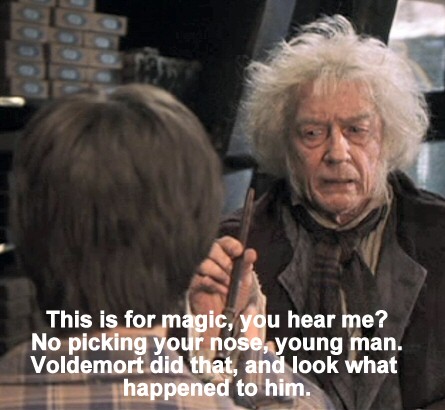
Magical Helper:  The hero goes to this character for “magic” for the journey. This might mean spells, amulets, science, technology, a secret weapon, etc. In the Harry Potter books, all of Diagon Alley played this role to some degree, but especially Garrick Ollivander. The wand maker had the responsibility and talent of matching this most important of magicians’ tools with the right wizard to wield it.

Loved One:  The Loved One is often The Loved One Left Behind of the Tearful Parting. This can be a spouse, parent, sibling, friend, beloved talking goat—doesn’t matter. They often are also a Threshold Guardian.

Threshold Guardian:  These guys are your Debbie Downers, and you can have more than one in a story. They’ll tell your hero that going on the Journey is a bad idea. They’re not wrong, but it doesn’t matter, because your hero is going to ignore them.

Shape-shifter:  Let me be clear, I’m not necessarily talking about a werewolf type shape shifter although you can certainly let the character have more than one physical form. I’m talking about someone who emotionally/mentally is a metaphorical shape-shifter. A great recent example of this is Thomas Hardy’s character Eames in Inception. He can become whatever character is needed in a dream and thus is known as “The Forger.”

Sam and Dean can't escape the Trickster.

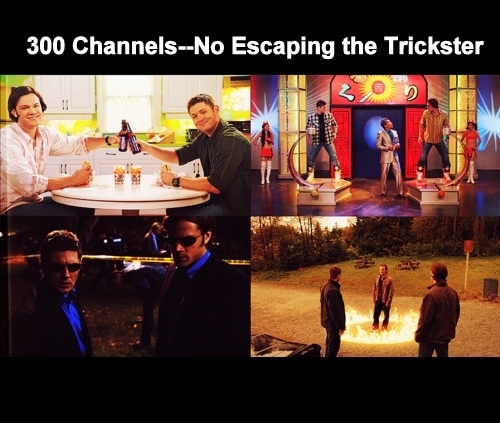
Trickster:  This is a common trope and great for laughs as your hero is thrown into sticky situations. One of the funniest episodes of Supernatural ever is “Changing Channels,” where Sam and Dean are stuck in a T.V. world created by the Trickster God. (Yes, I know he wasn’t actually a god, but no spoilers!)

Fool:  Slightly different from the Trickster, who is generally seen as clever, the Fool is regarded as dumb. However, the hero recognizes his/her wisdom, which becomes apparent to everyone by the end.

A God with Clay Feet:  I’m unsure if this character is ever a woman. This is a very, very common character in romances. He’s almost always the Lover for the Heroine at the beginning who is clearly wrong for her. He’s usually perfect on the surface. As the story goes on, though, we discover he’s cheating, is rude to her best friend, and is secretly kicking puppies.

The Herald:  The Herald doesn’t necessarily even have to be a person; it just has to issue the Call to Adventure. In the Mission Impossible movies, it’s just a recording that self destructs.

Q in Skyfall

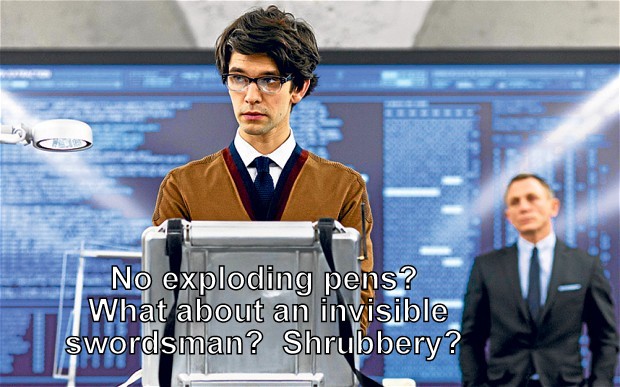
The Armorer:  In Sword and Sorcery fantasy, this could very well be a blacksmith handing over a sword, knife, mace, or other things pointy. In Bond films, it’s Q giving 007 the latest gadget. The Armorer does not have to give your hero something made of metal. In Cinderella, her Fairy Godmother was the Armorer, providing her with gowns, glass slippers, and pumpkin coaches to win the war of love.

The Rival:  The Rival is in love with the Hero’s Lover, forcing the Hero to compete for the Lover’s affections. He/She is usually preferred by the Hero’s family and friends, providing more conflict for your story. The Rival doesn’t have to lose. A great example of this is My Best Friend’s Wedding. Cameron Diaz was Julia Robert’s Rival, but she got the Lover in the end.

The Saint:  There’s a bit of variety here. The Saint can be an innocent or a world-weary intellectual. They are often priests, monks, bishops, and the like, but you don’t have to be clichéd. Jean Valjean in Les Miserables was a Saint, and he also was an ex-con.

Various Female Archetypes:  The Mother, Goddess, Nymph, Crone, Whore, Bitch, and Femme Fatale can all make appearances or be doubled up with another character. Your Lover can be a Femme Fatale, or your Mentor the Mother. The Rival is often a Whore or Bitch. If you are unsure of any of these archetypes, again, check out that article on Jung.

Whew!  That is a lot of people.

Related Reading:

Hero Archetypes

Of Arthurs and Lancelots: Mythic Origins of the Irritating Polygon (a lengthy, but interesting history of the love triangle, arguing that it might be an archetype in and of itself)

Up Next:  The Mythic Hero, or, Anti-heroes Need Not Apply

Does Your Hero Laugh in the Face of a Three Act Structure?

Victoria Grefer over at Creative Writing with The Crimson League (one of my Versatile Blogger Award nominees) recently did a series on heroes. She covered the reluctant hero, the willing hero, the anti-hero, the misjudged hero, and a caveat on classifying your heroes. Throughout the posts, and especially in the comments section, a book title popped up again and again, The Hero with a Thousand Faces by Joseph Campbell.

For those of you, like me, that did not get a degree in English or Literature, you might not have heard of Campbell or his book. I only stumbled across his name for the first time a month ago. However, if you’ve read a lot of fantasy and watched a lot of movies, chances are you’ve learned the lessons of his book without knowing it. You might even have written a novel following Campbell’s principles. I had.

The Hero with a Thousand Faces is a book about myths. If you look through the history of myths throughout time and across cultures, they all share a similar structure. Myths deeply resonate with the reading public, even today.

Yeah, yeah, academic stuff. Yawn. I’m writing page-turning fiction here, Lara. Who cares about dusty old myths? Speilberg, J.J. Abrams, Tolkien, J.K. Rowling, Iron Man, Superman—I’ll stop there or the rest of the post could be a listing of examples of successful movies and books that use Campbell’s structure, which is often just called the Hero’s Journey.

Discovering the Hero’s Journey was a huge relief to me. I had been trying to shove my plot into a basic three or five act structure and it just wouldn’t fit, even after I sat on it and really tugged on the zipper. I could still make out the muffled voice of my heroine shouting snarky insults at me.

Trying to shove your characters into a 3 act structure might not work.

If your hero is just as hard to wrangle into those basic plotting devices everyone keeps telling you about, maybe it’s because he/she wants to be a hero of mythic proportions. If so, let your hero go on a journey. The following outline appears in A Writer’s Guide to Fiction, and author Elizabeth Lyon even put it in a nice three act structure for us perfectionist rule followers.

Act One:  Departure, Separation

  1.  The Ordinary World/Hero at Home: Give your reader a little bit of normalcy before you send your hero off to face danger. Show them at work, with family, maybe even a current love interest. Make sure there’s still conflict. Just because they are at home, it doesn’t mean the story has to be boring.
  2. Call to Adventure/The Challenge:  Okay, now things are getting interesting. Will the hero go to slay the dragon, solve the crime, or embrace that he now gets furry every full moon?
  3. Refusal of the Call/Elimination of the Expendable Person:  Maybe your hero is ready to go right away, but the story is a lot more dramatic if he says no first. Then that not-right-for-them girlfriend can get killed and raise the stakes, making the hero that much more committed when they do answer the call.
  4. Meeting with the Mentor/Wise One:  Your hero is about to enter into a strange new world and needs guidance. Where would Luke Skywalker have been without Obi Wan and later Yoda?
  5. Crossing the First Threshold into the Special World/Mythical Woods:  In fantasy, a lot of times this actually means crossing into a new world. However, it doesn’t have to. If you write mysteries, it means crossing into the world of the killer. For romance, it could just mean entering the world of the love interest and all the vulnerability that entails.

Act Two: Descent, Initiation, Penetration

  1. Road of Tests and Trials/Allies and Enemies:  This is where you hit the real meat of any novel. You’re writing scenes of conflict between your protagonist and antagonist.
  2. Approach of the Inmost Cave:  The hero and his allies are preparing for the big event, usually a major face off with the antagonist.
  3. Belly of the Whale/Meeting with the Goddess, Temptress; Atonement:  This stage isn’t always listed, but adds another trial for your hero. Feeling mean? Throw a time of desperate solitude at him, or a temptress, or guilt, etc. right before he has the big battle.
  4. The Ordeal/Life and Death Struggle:  Now your hero is ready to face death or his greatest fear. Often this is the first major battle with the villain.
  5. Reward:  The hero usually gets something out of facing death. It can be a sacred object like a grail or a spell, or finally winning the love interest, or knowledge for the community, etc.

Act Three:  Return

  1. Refusal of the Return/The Road Back:  About three quarters of the way through the book, the hero wants to return home with the reward. The antagonist usually chases him.
  2. The Ultimate Test/Resurrection:  This is your climax. Almost home, the hero has one last battle where he must make a sacrifice. He may or may not die, and whatever personal growth you’ve been working on throughout the story needs to be resolved here. The death/resurrection is usually metaphorical as the hero becomes a new person, but with fantasy sometimes he just might die and come back.
  3. Return with the Reward/Elixir/Master of Two Worlds:  The hero makes it home and as he is changed, can now help change his community. Sometimes he answers a new call to adventure, also known as a sequel.

For you visual learners, here’s a handy-dandy graphic to keep all those steps straight from Christopher Vogler:

Graphic of the Hero's Journey

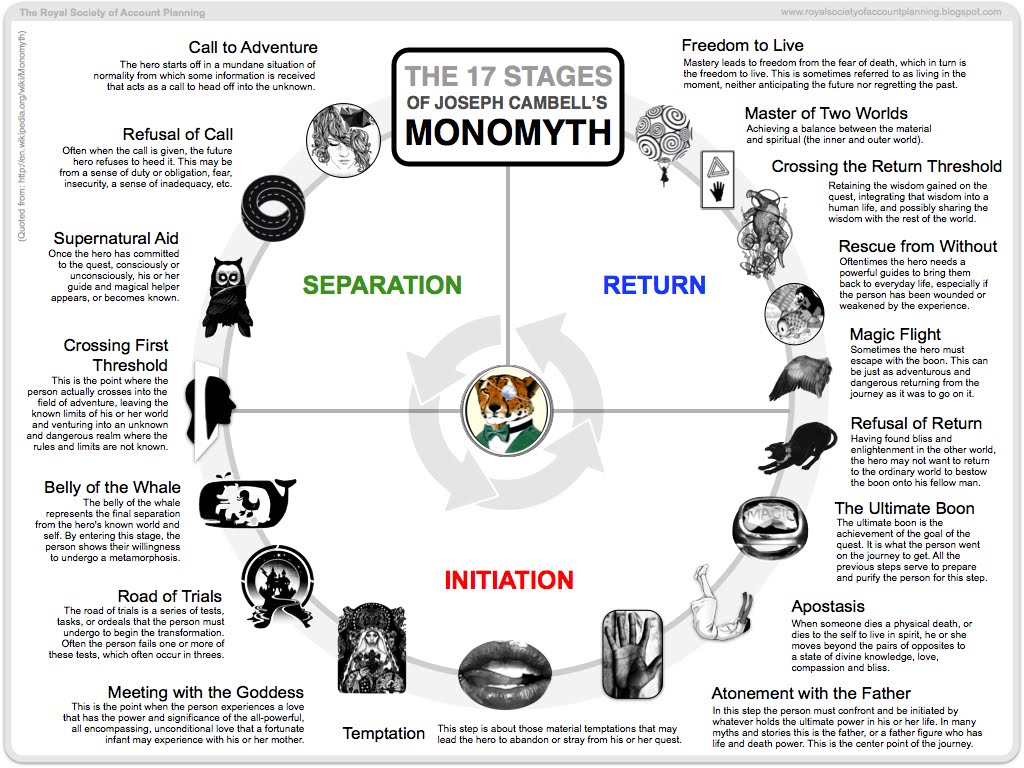
Or, for you overachievers, if you’d like the full 17 step super duper original Campbell version, here you go:

Campbell's Hero's Journey Graphic

Does your hero or heroine play nice with traditional plotting devices?  Does the myth structure fit you better, or have you found yet another way?

Related articles:

The Heroine’s Journey (the first post of twelve) The blog takes an in depth look at Campbell’s structure using the 2011 film adaptation of Jane Eyre.

Women Protagonists in Fantasy Fiction

Up Next:  The Cast of Characters in the Hero’s Journey

The Versatile Blogger Award

versatile-blogger

Like most writers and other human beings, I enjoy a compliment every now and then.  Sara Evans at A Place That Does Not Exist recently awarded me the Versatile Blogger Award.  I’ve enjoyed Sara’s blog, so it was nice to know she has also found mine worth reading.  I particularly like the spirit of the Versatile Blogger Award in that it encourages you to immediately award it to other bloggers yourself.

I was just conversing with another blogger this week about how writing can be an isolating profession.  Encouragement from other writers traveling the same path can go a long way.  Thanks to Sara for providing that this week for me.  I hope the bloggers I have listed below feel similarly encouraged.  I have followed and enjoyed your writing, and I hereby bestow the Versatile Blogger Award to you.  If you accept, proudly display the award and then share the love with ten bloggers you have valued.  Also, share seven fun facts about yourself.  If you don’t do awards, just know you have a fan in me.

In no particular order:

Creative Writing with The Crimson League:  Victoria Grefer consistently puts out informative and interesting posts on grammar, style, plotting, sequels, you name it.  I don’t know where she finds the time to post so often, but I’m glad she does.

Michelle Proulx:  Michelle self-published her first novel, and she has been wonderfully candid about the process so that the rest of us can learn from her experience.  She also happens to be hysterical.  Her recent post on haikus, where the comments that followed were also done in haiku, is just one example of how she keeps me in stitches.

Kira Lyn Blue:  Kira has just finished up a great series about keeping urban fantasy fresh, and she is now working on one with systems of magic.  If you write fantasy, I highly recommend following her.  Or, if you like funny pictures of squirrels.  Kira is the queen of the squirrel graphic.

Mired in Mundanity:  Rhyan posts a lot of advice from successful authors, but I enjoy his original posts best.  I’ve bookmarked more than one in my writing folder because he gives such rich, practical advice for building better stories.

Page After Page:  If Vicki’s GIFs are any indication, we watch the same TV shows, but that’s not why I like her blog.  Vicki’s blog is for traditional publishing what Michelle’s is for self-publishing.  She is kind enough to share her adventures about searching for agents and making pitches at conferences.

The Writer Diaries:  Vicki kind of gets a double nod here.  She writes for this blog with eight other writers.  I found this one first, actually.  Some of the contributors are self-publishers, others are going the traditional route.  They do book reviews, answer questions, and cover writing and publishing topics.

Christopher Davis Writes:  He’s been writing off and on lately about social media and its effectiveness for writers.  As someone else who is trying to figure out where the balance between beneficial and time suck lies, I’ve appreciated them.

Andy English:  Andy is new to the blogging game.  In fact, he’s only posted four times so far.  He was kind enough to share three short stories from the world of his novel.  People, they are good.  He should have made us pay for them.  Read them while his stuff is free.

Readful Things:  Ionia Martin mostly does book reviews, but she also has amazing guest blog posts.  I’ve trolled her archives and found all kinds of helpful information.  She also does a great sassy comment.  I think I actually found her via comments she left on other people’s blogs.

The Self Publisher:  Michelle gets two nods, I guess, too.  This blog is another site with multiple contributors, all of whom consistently post helpful information.  Even if you don’t self-publish, they have good marketing advice any author can use.

And my seven fun facts about me:

1.  I also write a food blog, although it’s been sorely neglected since I started this one.  Its tagline should be:  Great recipes.  Terrible pictures of food.

2.  I like house swapping (like in the movie The Holiday), and I’ve visited three other continents that way.  If you want to know how to do it, I’ve written an article how here.

3.  I find the beach too wet and sandy.  My husband finds this humorous for some reason.

4.  I got married at 20.  Fourteen years later, I still think it’s the best decision I ever made.

5.  My cat has a middle name–Jayden.  We did not give it to her.  A precocious four-year-old named the cat after herself.

6.  I get so excited about pilot season and TV starting up again, every fall I make a spreadsheet.  Yep, serious TV nerd.

7.  I write prodigiously long blog posts, but if you’re still reading this, you already know that.

A Writer’s Best Resource For Showing Not Telling

The Emotion Thesaurus by Ackerman and Puglisi

Christmas came early for me this year in the form of Amazon’s marketing genius. While buying yet another book on writing, I spied an intriguing title under Amazon’s Frequently Bought Together headline:  The Emotion Thesaurus. What in the world is that?

It’s Christmas, your birthday, your anniversary, and Happy Writer’s Day all wrapped into one beautiful gift from authors Angela Ackerman and Becca Puglisi. These attractive, talented, wonderful, intelligent, funny (No, I don’t really know them, but I’m grateful, okay?) women have compiled a resource that every writer would probably shell out fifty bucks at least for, but Amazon is only asking $12.32.

So let me unwrap this divine present from the writer goddesses for you. Pick an emotion that a character would feel. I’m feeling pretty Adoring towards Ackerman and Puglisi right now, so let’s use it. Keep in mind as I take you through this in depth entry for Adoration, that there are 74 more emotions covered in this book.

First you get Adoration’s definition. Next comes a list under the heading Physical Signals. This list includes thirty-two outward indicators that a character might be experiencing adoration. These signals would be obvious enough that not only your reader should pick up on them, but the other characters in a scene should be able to observe that the character exhibiting them is Adoring someone or something. For example: lips parting, nodding while the subject speaks, releasing an appreciative sigh, etc.

I would have been thrilled with just this first list. Instead of writing telling sentences like, “The heroine adored her big brother and listened to everything he said.”  I now had a list that helped me come up with showing sentences like, “Big Brother spoke of his most recent battle, and Heroine listened with her lips parted, nodding encouragement every time he paused.”  However, the entry doesn’t stop there.

The next heading under Adoration is Internal Sensations. Ackerman and Puglisi give us seven more ways to show Adoration from the perspective of the character experiencing it.  This list included descriptors like quickening heartbeat, breathlessness, and feeling one’s pulse in the throat.

If our heroine adored a love interest instead of her big brother, she might want to be a bit more subtle and hide those outward cues. The Internal Sensations then become very useful. “Love Interest drew closer to Heroine. She bit back a sigh, but she could not help the pulse pounding in her throat.”

But wait! There’s more. Our next section is Mental Responses, a list of five. These are great for helping you craft inner monologue for your POV character or providing her motivation in a dialogue scene. For example, using the authors’ suggestion of “an inability to see the subject’s flaws or faults” gave me the idea for the following short dialogue exchange:

Heroine:  “Love Interest would be a great father.”

Best Friend: “You mean the guy who can’t keep a goldfish alive?”

Heroine:  “That’s different. A kid would ask for food.”

With Cues of Acute or Long-Term Adoration, things really get fun. Thirteen more suggestions are listed, and these could lead to some intense conflict:  stalking, fantasizing, and taking on traits or mannerisms of the subject. “Heroine could almost feel Love Interest’s caress as she flushed goldfish number twelve.”

The authors note that acute or long-term adoration can escalate to Love, Desire, Frustration, or Hurt and give you the page numbers for each of those emotions, so you can look up all the goodies they’ve given you for them, too.

The final section of the Adoration entry is Cues of Suppressed Adoration. Nine more ways of showing instead of telling are provided for you. The list includes clenching or hiding one’s hands to hide sweating or shaking, avoiding conversations about the subject, and creating chance run ins.

I’d give you another example, but what you really want is the link. Merry Christmas. The Emotion Thesaurus by Ackerman and Puglisi.

Description Envy

In the last few weeks I have been captured by some particularly vivid description. The writing was so delightful that the image the author created has lingered with me. Even after just one reading or watching, I can remember the exact phrasing.

I know this case of description envy is worse because I need to improve my skill at adding detail and metaphor to my writing. For some reason, I just thought it came naturally to some people, but while reading yet another book on the craft of writing, I was disabused of this notion. Those perfect phrases I wish I wrote are the hard work of a writer who has discarded the first, second, and perhaps even the third or fourth thought that came to them. Only after digging deeper does the author reject the cliché, then the slightly overused, and the done before, to land on the fresh idea.

To help inspire you to excavate your own creativity, I thought I’d share some of the wonderful phrases that had made me so envious. The two sources are remarkably different, but both are impressive in their genres. I’d like to note here, too, that neither is the genre I write (fantasy). One of the best ways to get fresh ideas is to read and watch outside your niche.

House of Cards

Yes, it’s been available on Netflix for a while, but I was busy binge watching Arrested Development and Orphan Black. HoC’s recent Emmy nominations and a friend’s nagging finally prompted me to watch it this week. I’m only two episodes in at this point, but I might have to start watching with pen and paper in hand. Kevin Spacey’s character has a knack for metaphor that reveals as much about his character as what he’s describing. His dialogue repeatedly distills complex situations and emotions into perfect short phrases. Here are few of my favorites, which I wish had come out of my characters’ mouths:

In reference to his wife and their rather peculiar relationship: “I love that woman. I love her more than sharks love blood.”

On having breakfast with the Speaker and Majority Leader of the House: “They talk while I imagine their slightly salted faces frying in a skillet.”

While the martyr falling on his sword is a cliché, HoC did it in a fresh enough way it was clever again: “What a martyr craves more than anything is a sword to fall on. So, you sharpen the blade, hold it at just the right angle, and then…”  Spacey looks to the martyr character and waits, “3,2,1…” and the character metaphorically falls.

A Food Blog on Beer

I’m not really a beer drinker. There are a few I don’t mind, but in the hot of summer, I’d much prefer sangria or a good mojito. Honestly, if given the choice, I’ll drink water before beer. So why did I read an article online entitled 36 Cheap American Beers, Ranked?  Because a beer drinking friend of mine couldn’t stop laughing while he read it in my presence. After about the third excerpt he read out loud to me, I made him text me the link. Taste, smell, and touch are some of the least used senses in fiction writing. The descriptions of the beers were so overflowing with details from these neglected senses that I got grossed out a couple of times. I’m never going to drink any of these beers, but that doesn’t mean I can’t be challenged by word pictures like the following:

“Keystone separates itself from the rest of the crap pack by augmenting the typical stale/sour flavor profile with notes of brown bananas and green armpits. Keystone is worse than Heineken and murder.”

Rolling Rock. Smells like three fat guys in a two-man tent.”

Miller Genuine Draft. Tastes like the brown ends of corn silk, plus lemon.”

“It’s[Stroh’s] marred by a rubbery slickness that leaves your tongue feeling like third-day deli ham.”

In another brilliant example of changing a cliché for a startling and hilarious effect: “Milwaukee’s Best. It’s easy to mock the Beast, but it’s all I drank in college and I turned out.”

My friend’s personal favorite, which even two weeks later he’ll remember and then start laughing again: “Olympia. This one smells a little bit like the produce section of a carpeted grocery store, but it goes down pretty smooth otherwise.”

The whole article is worth reading.  Both because of its content and language, I would say the MPAA would give an R rating, so be advised. 36 Cheap American Beers, Ranked by Will Gordon.

Related Reading:

People Watching